


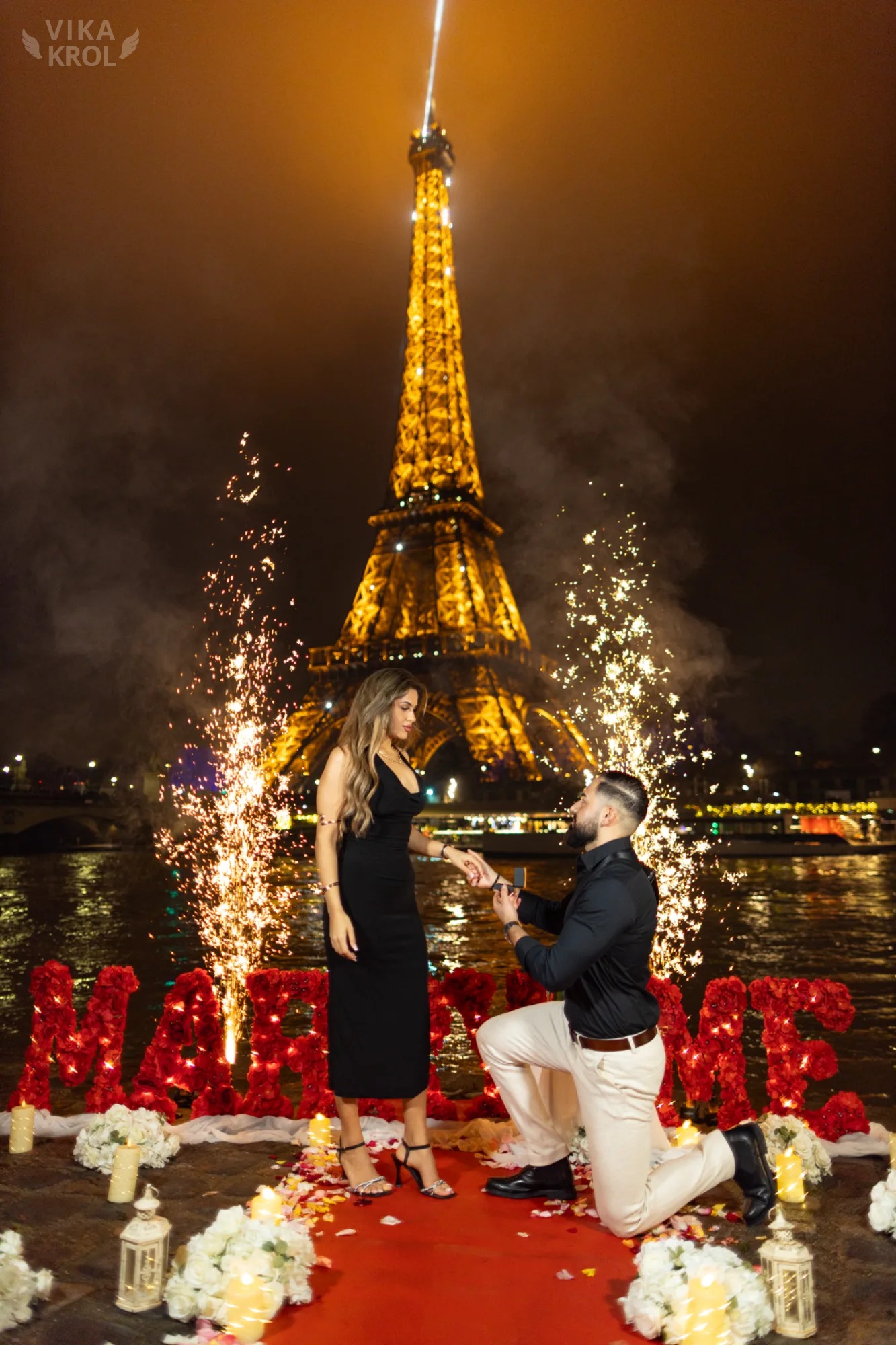
There is a pervasive, romantic illusion about proposing in Paris. You picture a quiet moment, the Eiffel Tower providing a picturesque backdrop, and a simple photograph capturing a spontaneous tear of joy. But what if the secret to a flawless moment wasn’t just finding a good photographer, but the right kind of secret agent for your emotions? For anyone planning this once-in-a-lifetime question, understanding the role of a true paris proposal photographer is the first step. The truth, honed over thousands of hours of planning, is that the most effortless-looking moments are, in fact, the most meticulously orchestrated productions.
| The Common Myth | The Unseen Reality |
| Any professional photographer can capture a proposal. | It requires an orchestrator, not just a spectator, to manage the surprise. |
| The “golden hour” is the best time for romantic photos. | The 5-minute Eiffel Tower sparkle is the real magic, demanding surgical precision. |
| A high-end camera guarantees great night shots. | Professional off-camera lighting is essential to balance ambient glare with facial emotion. |
| Getting hundreds of raw photos is the best deal. | The true luxury lies in receiving a curated, perfectly retouched gallery without the stress of choice. |
Myth #1: A Photographer’s Job Is Just to Take Pictures
This is perhaps the most widespread and dangerous misconception. Many assume a photographer’s role is passive: to stand at a distance, wait for the big moment, and click the shutter. You find them online, they have a lovely portfolio of smiling tourists, and you agree to “meet at Trocadéro at 8 PM.” What could possibly go wrong? As it turns out, everything.
The stark reality is that a proposal specialist is an active director, a silent orchestrator of your emotions. The second your partner suspects a camera is pointed at them, the genuine shock—the very emotion you want to capture—is compromised. A generalist photographer, accustomed to posed sessions, might stand too close, fidget with their gear, or make accidental eye contact, instantly signaling that something is afoot. The surprise evaporates, and the organic reaction you dreamed of becomes a slightly stilted performance.
In contrast, a specialist’s work begins long before the camera is even out of the bag. The entire experience is choreographed. Instead of a vague meeting point, a personal coordinator might meet you blocks away from the location, operating under a clever alibi. You could be “on your way to a secret rooftop bar” or a “private boat tour.” A simple, elegant mask is then introduced for your partner. This isn’t just for dramatic effect; it’s a powerful tool that completely preserves the surprise until the final, breathtaking second.
While she experiences a moment of playful mystery, thinking it’s all part of a fun game, the entire team is communicating behind the scenes. The photographer is already in position, often disguised as a landscape artist or a tourist. The lights are set. The music cue is ready. You are guided to your exact mark—a spot predetermined for its perfect view, impeccable lighting, and seclusion, a strategy also embraced for getting perfect engagement photos. There is no fumbling, no frantic last-minute texting, no awkward “is that him over there?” dance. You are completely free to simply breathe and focus on the life-changing question you are about to ask.
This is the fundamental difference:
- The conventional approach: You are left to manage the logistics, timing, and the immense pressure of keeping the secret.
- The specialist approach: The entire experience is wrapped in a seamless narrative of comfort for you and pure, unadulterated wonder for her.
The photographer doesn’t just capture the moment; they are an integral part of an invisible team that meticulously builds it.
Myth #2: The ‘Golden Hour’ Is Always the Most Romantic Timing
Any photographer worth their salt knows about the “golden hour”—that magical period shortly after sunrise or before sunset when the light is soft, warm, and universally flattering. For portraits, family photos, or fashion shoots, it’s undisputed perfection. Many planners and generalist photographers will suggest this time for a proposal, and on the surface, it makes perfect sense. It’s undeniably romantic, the light is beautiful, and Paris is bathed in a warm, cinematic glow.
But for a truly iconic Paris proposal, this is a rookie mistake. The truth is, the single most breathtaking moment in the city doesn’t happen during the golden hour. It happens in the dark.
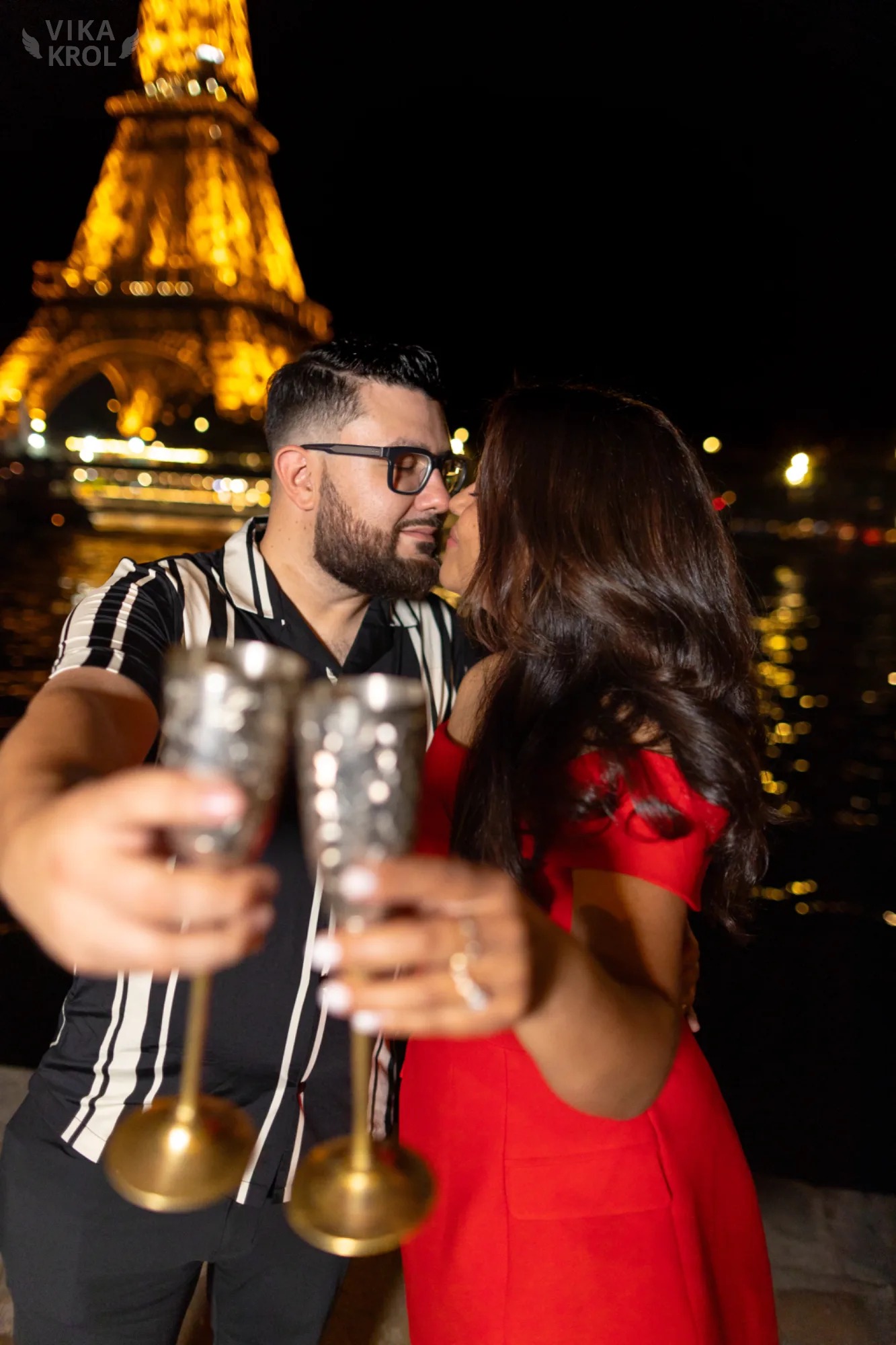
Every hour, on the hour, after nightfall, the Eiffel Tower erupts into a dazzling five-minute spectacle of 20,000 twinkling lights. This is the real magic. This is the cinematic backdrop that makes her gasp. It’s not just a pretty light show; it is a shared, city-wide event that feels uniquely Parisian and deeply special. To propose during this fleeting window elevates the moment from beautiful to truly unforgettable. But here’s the critical catch: you have exactly 300 seconds.
A specialist doesn’t just “aim” for the sparkle. They build the entire timeline around it with surgical precision. The process is a finely tuned choreography:
- H-10 Minutes: You and your partner are being guided to the location under the chosen alibi, with the coordinator ensuring a calm, unhurried pace.
- H-2 Minutes: You arrive at the spot. The coordinator positions you and your partner perfectly, making casual conversation to keep everything feeling natural.
- H-0 Minute, T-0 Second: The very first twinkle illuminates the Tower. That is the signal. The pre-selected music starts to play. She is invited to remove her mask.
That precise, coordinated start is impossible to achieve with a photographer who just says, “let’s shoot around sunset.” They might get you there at 9:30 PM, but by the time you find the right spot and get into position, you may have missed the 9:00 PM sparkle and be far too early for the 10:00 PM one. You are left in a beautiful but ultimately static scene. A proposal specialist understands that the emotional peak is reached when the environment itself participates in the surprise. The difference is proposing in front of a sparkling Eiffel Tower versus proposing at the exact, heart-stopping moment it begins to sparkle just for you.
Myth #3: A Professional Camera Makes Night Photography Easy
Modern cameras are technological marvels. With astounding low-light capabilities and sophisticated sensors, it’s easy to believe that a professional-grade camera is all you need to capture a beautiful night scene. This leads many to think that as long as the photographer has expensive gear, the night photos will be stunning. This is a deeply flawed and costly assumption, especially in the unique and challenging lighting environment of a Paris proposal.
The technical challenge is immense: you have one of the brightest, most complex light sources in the city (the sparkling Eiffel Tower) directly behind two human figures in relative darkness. This is a scenario of extreme dynamic range that pushes any camera to its absolute limit. An unassisted camera, no matter how advanced, is forced to make a choice:
- Expose for the Tower: The Eiffel Tower looks perfect, crisp, and beautifully lit. The result? You and your partner are reduced to dark, unrecognizable silhouettes. The emotion is lost.
- Expose for the Faces: Your expressions of joy and surprise are visible. The result? The Eiffel Tower behind you is a blown-out, overexposed white blob, completely devoid of its iconic detail or magic.
This is where the expertise of a night proposal specialist becomes non-negotiable. They don’t rely on the camera’s automation; they become masters of light. The secret is not just having external lights, but knowing how to use them with artistic subtlety. A true expert uses professional, off-camera lighting—often portable, battery-powered LED panels fitted with softboxes—to delicately “fill in” the light on the couple. The goal is to add just enough illumination to capture every nuance of emotion on your faces without making it look artificial or staged. The light must feel natural, as if it’s simply part of the ambient romance of the city.
This requires a deep, practical understanding of light temperature, angles, and intensity ratios. The crafted light on you must perfectly balance with the ambient light from the Tower. It’s a delicate craft honed over hundreds of night proposals in varying weather conditions. A photographer who primarily shoots in daylight simply does not have this muscle memory. They will either resort to a harsh on-camera flash (which destroys the atmosphere) or deliver grainy, underexposed images that fail to do the moment justice.
Myth #4: Getting More Raw Photos Equals Better Value
In the age of digital abundance, the idea of “more” often feels like a better deal. Some photographers offer packages where they deliver hundreds, even thousands, of unedited, “raw” image files. The sales pitch is compelling: you get every single shot, and you can choose your favorites to edit later. It sounds like you’re getting more for your money. In reality, you’re being handed a second job at the exact moment you should be celebrating.
Imagine this: the day after your magical proposal, you’re floating on a cloud of pure euphoria. You want to relive the moment and share the incredible news with family and friends. Instead, you’re faced with a download link to a folder containing 500 nearly identical images. You have to squint at tiny thumbnails on a screen, trying to discern the subtle difference between shot #247 (where your eyes are half-closed) and shot #248 (which is perfect). It’s overwhelming, time-consuming, and it pulls you out of the sublime emotion of the moment and into the tedious, analytical task of a photo editor.
A premium proposal experience understands that true luxury is not about quantity; it’s about curated quality and effortless comfort. A specialist team knows that their work is only halfway done when the shutter clicks. The next, equally important step is a meticulous post-production process:
- Expert Curation: An experienced eye personally reviews every single frame. They are not just looking for technically correct photos; they are hunting for the images that tell the story best: the quiet anticipation in your eyes, the genuine shock on her face, the single tear of joy, the triumphant, weightless embrace. They discard the duplicates, the blinks, and the unflattering angles, saving you from decision fatigue.
- The Art of Cinematic Retouching: Each selected photo then undergoes professional color grading and retouching. This is not about altering reality, but enhancing it to match the feeling of the memory. They ensure skin tones are natural and beautiful, the colors of the Parisian night are rich and cinematic, and every detail feels as magical as you remember it.
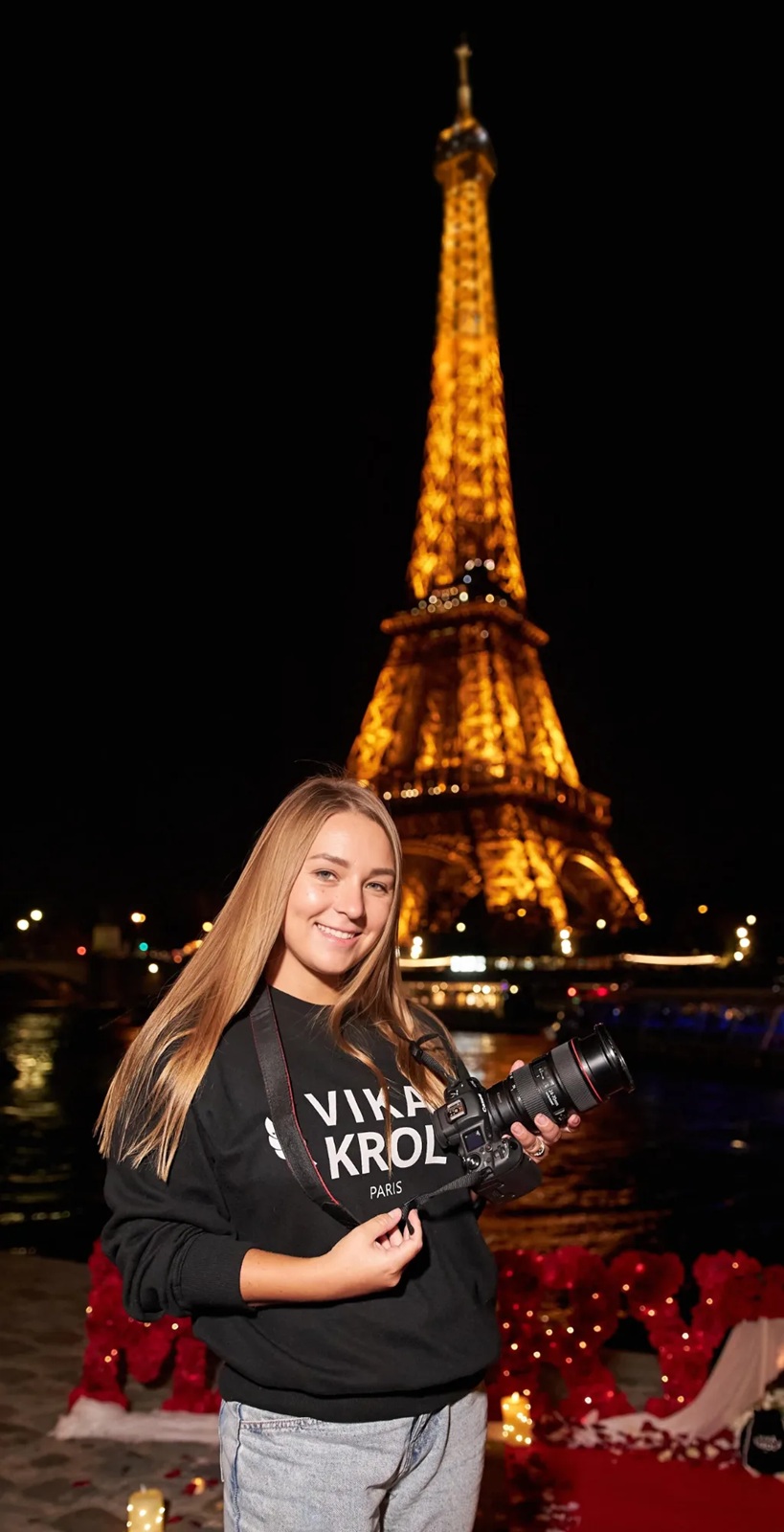
- Effortless Delivery: You don’t receive a chaotic folder of raw files. You receive a polished, elegant gallery of 100+ stunning, ready-to-share images that tell the complete, beautiful story of your proposal. Premier services like the Vika Krol Club even deliver the first selection of highlight photos within 24 hours, so you can make your announcement while the emotions are still vibrantly fresh.
Beyond the Camera: Choosing an Experience Orchestrator Vika Krol
When a moment is truly flawless, it looks easy. But behind every seamless proposal experience lies a foundation of deep, hard-won expertise. It’s the invisible architecture that supports the entire moment. This expertise is not just about photography skills; it’s a blend of logistics, psychology, and crisis management. It’s having a backup plan for a sudden rain shower that feels just as magical, not like a compromise. It’s about being able to guide a nervous fiancé with a calm, reassuring presence that melts away stress.
After personally orchestrating over 1,000 proposals in Paris, one truth becomes clear: perfection is not an accident. It is the result of relentless attention to detail and a profound understanding of human emotion. Your proposal is not just another event. It is a defining life moment, a memory that will be revisited for decades to come. Choosing the person to capture it is not a decision to be taken lightly. It’s about finding more than just a technician with a camera; it’s about entrusting your story to an artist and an orchestrator. That is the critical difference a true paris proposal photographer makes—transforming a simple plan into a cinematic, emotional masterpiece that feels as incredible as it looks.
Paris Proposal Photographer: Frequently Asked Questions
How can I stay natural and not feel awkward knowing a camera is there?
This is a very common and valid concern, and it’s where an experienced proposal team truly shines. Firstly, the surprise is paramount. For the most crucial moments—the walk-up and the question itself—your partner won’t even know a photographer is present, allowing for a genuinely authentic reaction. Afterwards, the photographer’s job is to be a gentle guide, not a demanding director. We encourage you to stay in the moment, to talk to each other, to laugh, and to simply enjoy the flood of emotions. A great photographer captures these authentic interactions from a distance, using prompts like “tell her what you were thinking right before you knelt down” rather than “look at the camera and smile.” The session naturally evolves into a celebration, not a stiff photoshoot.
What happens if it rains, especially during the Eiffel Tower sparkle?
Rain in Paris is not a crisis; for a prepared team, it’s an opportunity for even more romantic and unique photos. A professional always has a Plan B. This often includes elegant, transparent umbrellas that look beautiful on camera, protecting you from the elements without hiding your faces or emotions. The reflections on the wet pavement can create stunning, mirror-like effects, especially with the city lights creating a painterly feel. An expert photographer knows how to use the weather to their advantage, turning a potential worry into a memorable and distinctly Parisian part of your story.
Is a high-end smartphone really not good enough compared to a professional?
While modern smartphones take incredible photos in good light, they have significant limitations in a dynamic, low-light proposal scenario. Firstly, a professional camera with a high-quality lens offers vastly superior low-light performance, creating clean, crisp images without the distracting digital noise (grain) a phone produces. Secondly, and perhaps more importantly, a professional lens allows for optical “lens compression.” This effect makes the background (like the Eiffel Tower) appear larger, closer, and more majestic relative to the couple, creating a much more cinematic and grand image. Lastly, a phone can’t be operated by a hidden expert who is simultaneously managing off-camera lighting, coordinating timing, and handling crowd control. The tool is only a small part of the equation; the artist and orchestrator behind it are what truly matter.